


Enterprise IT Solutions
Your IT Team Has a Business to Run
Paragon Micro takes on the work that slows it down
Architecture, sourcing, integration, deployment and support brought together, so complexity, distributed sites and constrained capacity stop landing on your engineers.
Clear ownership. Less operational burden. More capacity to move forward.
Connected expertise. Clear ownership.
The Proposition
Take the Execution Burden Off Your Team
We bring architecture, sourcing, integration, deployment and support together, so your team carries less coordination and less rework.
-
Less time chasing answers
A named lead coordinates the specialists, the dependencies and the escalations, so your directors ask once and get a straight answer.
-
Better control of IT spend
Engineers review usage, licensing and architecture for avoidable cost, and hand you a plan you can act on before the next renewal.
-
Less work before deployment
Systems arrive configured, integrated and validated against requirements you approved, not as boxes your engineers have to finish.
Customer Results
The Work We Took Off Our Customers’ Teams
Three separate customer engagements, from Paragon Micro’s published case studies.
-
96hrs of customer setup and troubleshooting eliminated
A 12-server GPU deployment arrived configured and validated, so the customer’s engineers never did the build.
AI infrastructure case study -
50% less time spent verifying compliance
Network automation returned half the verification hours to the team that had been doing the checking by hand.
Network automation case study -
80+ locations standardized on one framework
Fragmented site infrastructure brought under a single network standard, coordinated across the whole estate.
Multi-site network case study
The Evaluation Question
What Will Your Team Still Have to Carry?
Every provider can list the same capabilities. The question that separates them is how much work is left on your side once the order is placed.
- Coordination work
- Who chases the vendors, the dates and the dependencies week to week.
- Technical decisions
- How quickly a qualified architect can be reached when the design has to change.
- Deployment preparation
- How much imaging, configuration and testing lands on your engineers at the site.
- Issue resolution
- Who owns the fix when something slips, and how the decision gets made.

The Real Cost
The Purchase Order Is Only the Beginning of the Cost
Every hour your engineers spend untangling delivery is an hour unavailable for the next business priority.
Chasing status, correcting configurations, resolving dependencies and absorbing delays rarely appears on a quote. It lands on the payroll you already have.
Where Delivery Goes Wrong
Four Ways IT Delivery Drains Your Team
Unclear ownership
Your team becomes the coordinator, holding the thread between sales, licensing, engineering and logistics.
Delayed technical decisions
Dependencies stall while a qualified architect is scheduled, and the schedule slips around them.
Unreviewed consumption and licensing
Avoidable cost carries quietly into the next renewal because nobody was asked to look for it.
Incomplete deployment preparation
Your engineers inherit the setup and troubleshooting that should have finished before the shipment left.
Each one maps to a commitment below.
The Operating Model
When the Plan Changes, Who Owns the Fix?
- 01
It surfaces once
Your team raises it with one named lead, not with four queues.
- 02
Specialists engage
The lead pulls in architecture, licensing or logistics as the issue requires.
- 03
Options are written
Impact, cost and timing documented, so the trade-off is visible.
- 04
You decide
The customer approves the path. We coordinate it, we do not assume it.
- 05
Closure is tracked
The same lead confirms completion and reports it on the agreed cadence.
Ownership stays with one lead across every team involved, so continuity does not depend on who happens to answer.
The Commitments
Four Commitments You Can Hold Us To
Each one has a named owner, a deliverable you receive and a measure we agree in writing before the work starts.
Accountable delivery
A named lead and a documented escalation path for the life of the engagement.
Answers Drain 01Direct engineering engagement
Architects involved at decision points agreed up front, not booked on request.
Answers Drain 02Spend discipline
Documented findings on usage and licensing, with recommended actions you can act on.
Answers Drain 03Deployment readiness
Approved configurations and validation records released before anything ships.
Answers Drain 04
Commitment One Accountable Delivery
One Accountable Lead, From Scope Through Delivery
One lead. Connected specialists.
- Project owner
- One named person responsible for the engagement end to end.
- Backup coverage
- A second named contact briefed on the work, so absence is not a gap.
- Escalation route
- Written, with the level it reaches and how quickly.
- Reporting cadence
- Agreed at kickoff, with the content of each update defined.
- Dependency resolution
- OEM, carrier and schedule dependencies worked by us, not forwarded to you.
- Scope of PM services
- Defined per engagement, so you know exactly what is covered.
Commitment Two Direct Engineering
Test the Decision Before You Fund the Rollout
In the Paragon Micro Lab your engineers validate performance, compatibility, user experience and operational fit, with an assigned subject-matter expert alongside them. The Lab spans all six solution practices, not one.
- Agreed test criteria
- Written before the proof of concept starts.
- Observed results
- Recorded against those criteria, not summarized.
- Deployment recommendation
- Proceed, adjust or stop, with the reasoning.
The Paragon Micro Lab
Commitment Three Spend Discipline
Find the IT Spend Your Business Can Stop Carrying
Engineers review the environment for avoidable waste. Redundancy that protects availability and recovery stays where it is.
- Usage findings
- What is actually running, and what is idle.
- Licensing overlap
- Where two platforms are paid for the same job.
- Savings opportunities
- Estimated, prioritized and attributed to a change.
- Contract constraints
- What your agreements will and will not allow.
- Recommended changes
- A sequence you can take into the next renewal.
Make every investment accountable
We assess how your people and workloads actually operate before we recommend a license, not after.
Commitment Four Deployment Readiness
Resolve Deployment Issues Before They Reach Your Team
- 01
Approved design
The architecture you signed off becomes the build standard.
- 02
Documented requirements
Imaging, BIOS, tagging and labeling written down, not assumed.
- 03
Configuration
Built and integrated in the System Readiness Center to that spec.
- 04
Testing and review
Validated, recorded and available for your review before release.
- 05
Release for delivery
Equipment arrives ready for the site, with its records.
Built. Checked. Ready.
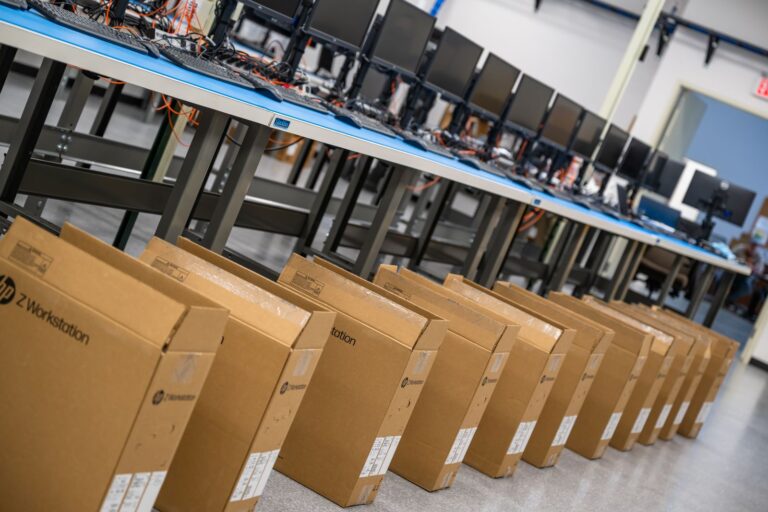
Less setup at the site, fewer avoidable corrections, more consistent rollouts.
Walk the floor and see it before you commit.
Core Solutions
Six Practices, One Delivery Model
-
Data Center
Build capacity. Protect uptime. Simplify the next refresh.
Server, storage, power and cooling, planned around your refresh cycle.
-
Networking
Keep every location connected and easier to manage.
One standard across sites, so adding the next one is not a rebuild.
-
Security
Reduce exposure. Strengthen recovery. Protect operations.
Identity, email, infrastructure and continuity covered as one program.
-
Cloud & Orchestration
Control cloud complexity and software spend.
Platforms, automation, governance and enterprise licensing in one review.
-
Data & AI
Build the foundation to put AI to work.
Modernized platforms and unified data before the model, not after.
-
Modern Workplace
Help employees work. Reduce the support burden.
Productivity, collaboration and AV aligned, right-sized and actually used.
Every practice runs under the same accountable lead and the same readiness process.
How to Evaluate
Five Questions to Ask Before Your Next IT Commitment
| Ask every provider | Evidence to request | What we put in writing |
|---|---|---|
| Who owns issues across the project? | Named lead, responsibilities, escalation path | One lead and a backup, named at kickoff |
| When do our engineers engage yours? | A technical engagement plan | Architects at agreed decision points |
| How will you identify avoidable spend? | Review scope and sample findings | Documented findings and recommended actions |
| What gets validated before deployment? | Test criteria and validation records | Approved configurations, records released with the shipment |
| How do we agree the work is complete? | Acceptance criteria and closeout documentation | Acceptance criteria agreed in the scope |
Where to Start
Give Us One Problem. Judge the Work.
-
Cloud and licensing review
- What you give us
- A slice of the environment or an upcoming renewal.
- Deliverable
- Prioritized cost opportunities, contract constraints and recommended actions.
-
Workplace consolidation review
- What you give us
- The licensing inventory and the renewal dates.
- Deliverable
- A platform overlap map and integration recommendations across workplace tools.
-
Deployment pilot
- What you give us
- One upcoming site rollout or refresh.
- Deliverable
- A defined rollout with agreed readiness and acceptance measures.
Scope, timing and commercial terms agreed before we start. Measured on customer effort removed, readiness, or validated savings opportunities.

Choose One Project. Make Us Prove the Difference.
Bring us an upcoming renewal, a deployment bottleneck or an integration challenge. We will define the work, the ownership and how you measure the result.
solutions.paragonmicro.com